
916-780-1000

How Dental Implants Help Preserve Your Jawbone and Facial Structure

When patients lose a tooth, the immediate impulse is usually to focus on the visible gap in their smile or the short-term difficulty in chewing favorite foods. However, as an experienced clinician, I always remind my patients that the most significant consequences of tooth loss occur beneath the gumline, out of sight. The biological health of your lower face relies on constant, direct stimulation from tooth roots to maintain bone density and shape. Without this continuous interaction, the surrounding bone tissue deteriorates rapidly through bone resorption, leading to shifts in neighboring teeth and subtle, premature changes to your facial features over time.
To address these long-term structural changes, evaluating modern restorative treatments becomes critical. At Pure Dentistry Rocklin, led by Dr. Darcé A. Slate, our team provides evidence-based restorative care designed to protect both oral function and long-term facial harmony. By combining advanced clinical techniques with personalized diagnostic planning, Dr. Slate helps patients make informed decisions about their lifelong oral health.
For patients evaluating permanent tooth replacement options, choosing our dental implants in Rocklin turns out to be a proven pathway to restore bite function. Moreover, it also protects the bone volume and facial architecture.
The Biological Connection Between Tooth Roots and Jaw Strength
To understand how tooth loss influences your appearance, it helps to review the biological relationship between natural teeth and bone density. Living bone tissue is highly dynamic and continually responds to mechanical forces, a medical principle recognized as Wolff’s Law. Bone tissue requires regular physiological stimulation to retain its mass and structural stability.
In a healthy mouth, this necessary force comes directly from daily chewing and biting:
When you bite down on food, energy travels down through the crown and into the tooth root, which transmits micro-signals across the periodontal ligament into the alveolar jawbone. These micro-signals prompt specialized bone-building cells (osteoblasts) to continually regenerate healthy tissue.
When a root is extracted or lost, that vital signal pathway stops entirely. Sensing that the local bone structure is no longer supporting a functional root, the body begins reabsorbing bone minerals to deploy elsewhere in the body. Over time, the alveolar ridge loses both height and width, creating a gradual decline in the foundation supporting your teeth and facial contours.
What Happens to the Jawbone After Tooth Loss?
Jawbone deterioration begins quickly following tooth extraction. Clinical research shows that up to 25% of the localized bone width can be lost within the first year if the root system is not replaced. As bone loss progresses, it creates a progressive chain reaction throughout the mouth:
- Shifting and Tipping: Nearby natural teeth lose their lateral structural support and tilt into the open gap, disrupting your natural alignment.
- Super-Eruption: The opposing tooth on the upper or lower jaw may shift out of its socket searching for a contact surface, exposing its own root system.
- Bite Misalignment: As teeth shift, your bite changes, placing uneven stress on remaining teeth and aggravating the temporomandibular joint (TMJ).
- Secondary Tooth Loss: Continuous localized resorption weakens adjacent bone support, increasing the risk of losing adjacent teeth down the road.
How Bone Resorption Changes Facial Features
Because the jawbone forms the structural foundation for the lower third of your face, substantial bone loss alters your external appearance over time. As bone mass recedes, the overlying soft tissues lose their support structure, leading to distinct aesthetic changes:
Sunken Cheeks and Hollow Profile
When bone in the posterior (back) regions of the mouth diminishes, cheek tissues fold slightly inward due to lack of support, giving the cheeks a hollowed appearance.
Deepening Facial Lines and Wrinkles
Without a firm underlying bone structure, the skin surrounding the mouth loses tightness. Facial folds running from the sides of the nose down to the corners of the mouth (nasolabial lines) and from the mouth to the chin (marionette lines) become more prominent.
Vertical Compression and Lip Thinning
The vertical distance between the tip of the nose and the chin is known as the vertical dimension of occlusion (VDO). As upper and lower jawbone heights decrease from resorption, this vertical height compresses. Consequently, the lips roll inward, appearing thinner and flatter.
A Protruding or Pointed Chin Profile
When significant bone loss occurs across the mandible, the chin angles upward and forward relative to the rest of the face, leading to a collapsed or pointed facial profile.
How Dental Implants Preserve Facial Structure
Traditional tooth replacements, like standard removable dentures or dental bridges, rest above the gumline. While these options effectively fill visible gaps and assist with basic chewing, they do not replace the underlying tooth root. Standard dentures exert force on top of soft gum tissue rather than stimulating internal bone, which means underlying bone loss can continue underneath the appliance.
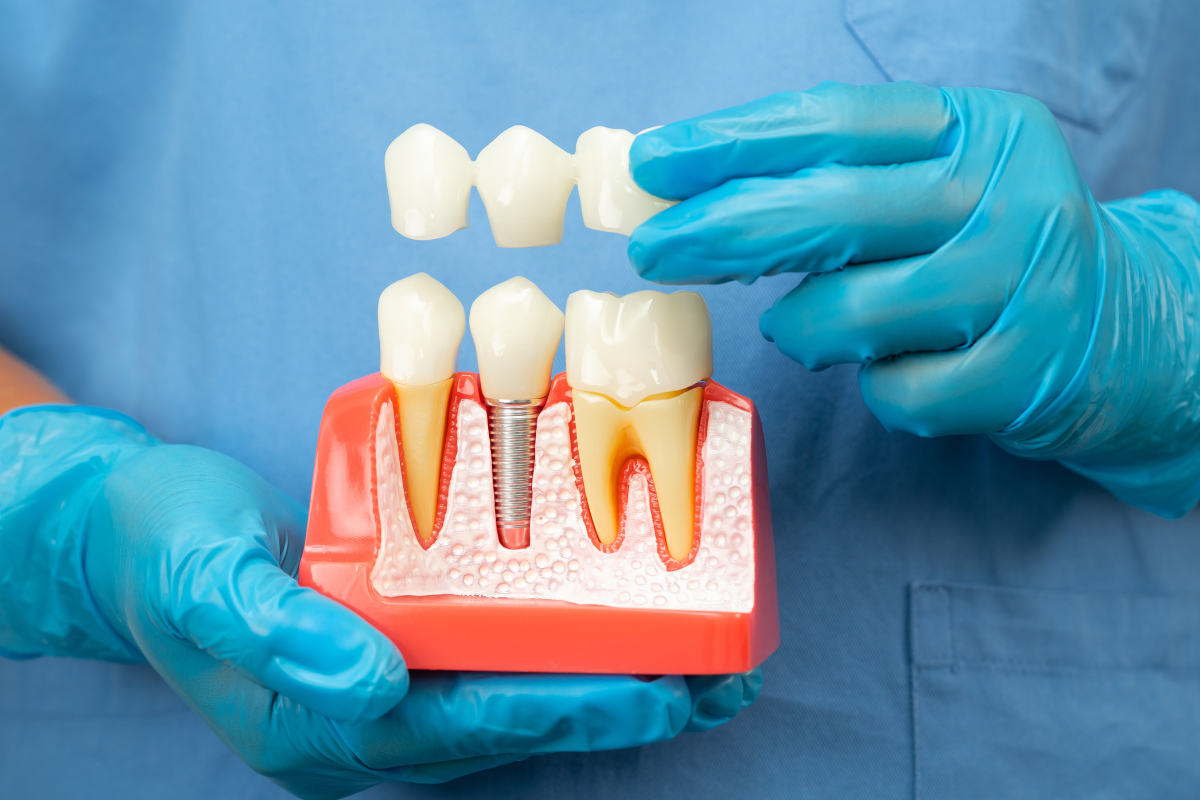
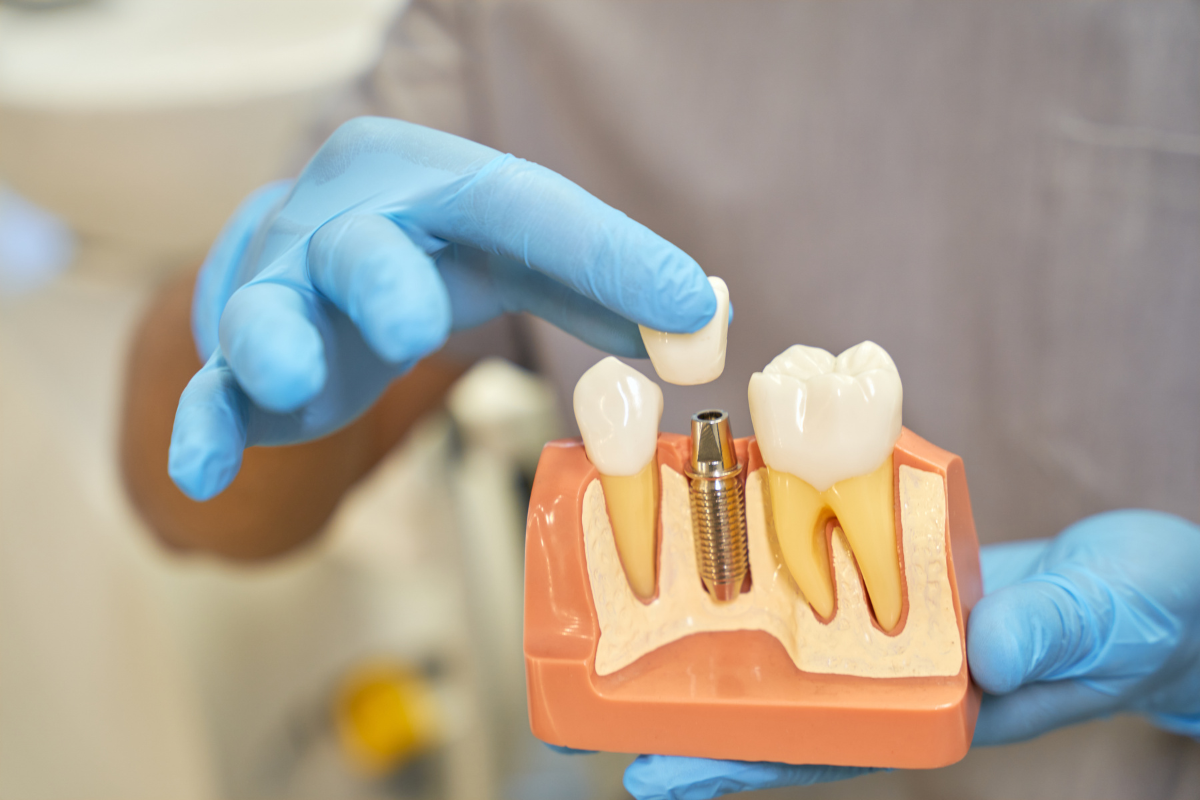
This key distinction is why, when considering dental implants in Rocklin, patients learn how titanium posts integrate into natural bone to preserve structural health. Implants are engineered to replace the full structure of the tooth, from root to crown.
This treatment preserves bone through a biological process called osseointegration:
- Surgical Placement: A biocompatible titanium implant post is placed directly into the jawbone at the precise location of the missing tooth root.
- Bone Integration: Over a period of three to six months, natural bone cells attach directly to the titanium surface, locking the post securely in place as an artificial root.
- Restoring Chewing Forces: Once an abutment and custom porcelain crown are attached, functional chewing forces travel down the post into the bone tissue, triggering normal osteoblast activity and helping prevent future bone resorption.
Protect Your Health and Smile Stability
Choosing implants is an investment in both your immediate oral function and your long-term facial structure. Beyond preventing bone loss and preserving facial contours, implants restore near-natural biting power, allow you to eat comfortably without slippage, and eliminate the hassle of temporary adhesives.
Whether you are seeking to replace a single missing tooth or looking for a permanent alternative to loose traditional dentures, customized restorative dentistry can restore your smile’s strength and stability.
To discuss your options for permanent tooth replacement, schedule a consultation with Dr. Darcé A. Slate and the team at Pure Dentistry Rocklin. Book an appointment today to take the next step toward preserving your smile, jawbone density, and long-term facial health.
Frequently Asked Questions(FAQ’s)
1. How do dental implants compare to traditional dental bridges?
Unlike traditional bridges that require filing down neighboring healthy teeth, implants stand independently. Implants replace the tooth root beneath the gums, which stimulates the jawbone and actively prevents the bone loss that traditional bridges allow over time.
2. Why choose dental implants over removable partial or full dentures?
Removable dentures sit on gum tissue, causing friction, bone resorption, and facial sagging. Implants integrate directly into your jawbone, restoring full chewing power, preventing facial collapse, and eliminating the messy adhesives, slipping, and frequent relining common with dentures.
3. How do full-size implants compare to mini dental implants?
Mini implants feature a narrower diameter and lower load-bearing strength, making them less ideal for heavy molar stress. Full-size implants provide maximum stability, withstand daily chewing forces, and ensure reliable long-term jawbone preservation.
4. Why choose dental implants over tooth-supported resin bridges?
Resin-bonded bridges offer limited structural strength and rely on light adhesive bonding to back surfaces of neighboring teeth. They frequently detach under chewing pressure and fail to stimulate the jawbone, whereas implants provide permanent, root-level stability.
5. Why do dental implants cost more initially than conventional dentures?
Conventional dentures require lower initial investment but involve recurring expenses for adhesives, relinings, and replacements every few years. Implants offer a permanent, lifelong solution that preserves bone density, preventing costly secondary dental procedures and continuous repairs.
6. How do dental implants compare to root canal therapy with a crown?
Root canal therapy preserves your natural root whenever biologically viable, making it the preferred first option. However, when a tooth is severely cracked or failing, dental implants serve as the most reliable alternative to replace untreatable roots permanently.
7. Are dental implants better than implant-supported snap-in dentures?
Snap-in dentures utilize two to four implants to retain a removable appliance, offering better retention than traditional dentures. However, fixed dental implant restorations provide individual tooth support, superior stability, convenience, and maximum protection against overall jawbone loss.